
Agastache
"liquorice plant"

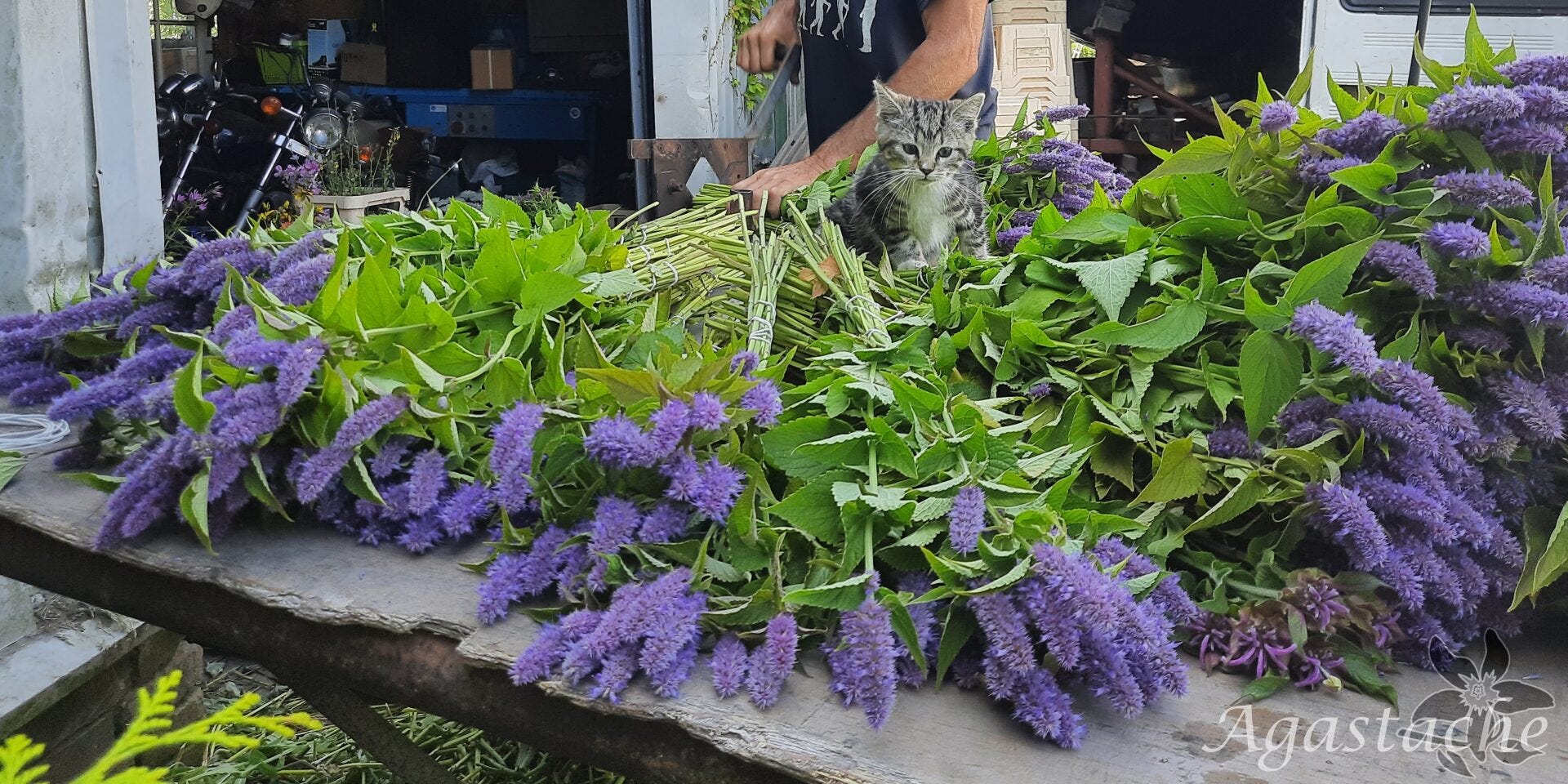
Agastache, like Mentha and Monarda, belongs to the aromatic plants. The Dutch name for this strong-smelling flower is ‘dropplant’ (liquorice plant). If you rub the leaves between your fingers, you will immediately understand where this name comes from.
Agastache is better known in gardens than in summer flower bouquets. Yet this flower has been sparsely available as a cut flower at Dutch flower auctions for decades. Agastache has narrow flower spikes with tubular flowers.
The Agastache comes in a range of colours, from white and blue to red and violet. Thanks to its attractive shape and colour, the Agastache is a popular choice for mixed bouquets. The Agastache is available throughout the summer.
From the grower.
Agastache is actually a perennial, but not a particularly hardy one. During harsh winters, many plants die, but after moderate winters, as has been seen in the Netherlands in recent years, most plants survive. Flower growers can cut flowers from these perennial plants earlier than from plants sown or planted out in spring. So, after a harsh winter, Agastache will not be available in flower shops in early summer.
Furthermore, the Agastache is a fairly easy plant to grow and produces lots of flowers. The trick is to space out the harvest as much as possible, because the product is small and there is a risk of oversupply on the market. It is better to harvest regularly over a longer time.
The grower achieves this by leaving a plot in place, allowing for an early harvest after a moderate winter. Additionally, new plots are planted or sown in sections to extend the flowering period. Sometimes, a biennial plot is cut back well before it flowers, causing it to flower later.
For the enthusiast.
Agastache belongs to the Lamiaceae family. This family also includes most nettles, such as the well-known stinging and dead nettle. It also encompasses a wide array of ornamental and herbal plants, including Ajuga, Leonotis, Mentha, Monarda, Origanum, Phlomis, Salvia, Stachys, and Thyme. These plants are all herbal and are sometimes used for ornamental or cutting purposes.
Many of the plants in this family are aromatic and would not look out of place in an herb garden. Agastache emits a scent that sits between liquorice and aniseed. Another common feature that you would only really notice if you paid close attention is that all the plants in this family have square stems.
The Agastache plant is native to Eastern Asia and Central America. The plant is called liquorice plant because it has a similar scent, but it is not the plant from which liquorice is actually made. Liquorice is made from the plant Glycyrrhiza glabra. A single Agastache plant can produce up to 90,000 individual flowers. The Apache (Native Americans) used Agastache as a medicine.
Vase life.
Basically, the Agastache has an extremely long vase life. Several weeks is not at all unusual. One potential issue is that spent flowers fall out. However, these flowers are immediately replaced by new ones, ensuring continuous flowering.
If you cannot stand the shedding, you can also very easily put this flower outside on the table on your terrace. The spent flowers will blow away by themselves. In a bouquet, this isn’t as much of an issue, as the other flowers in the bouquet catch them.
You can find availability of all our flowers on our website.